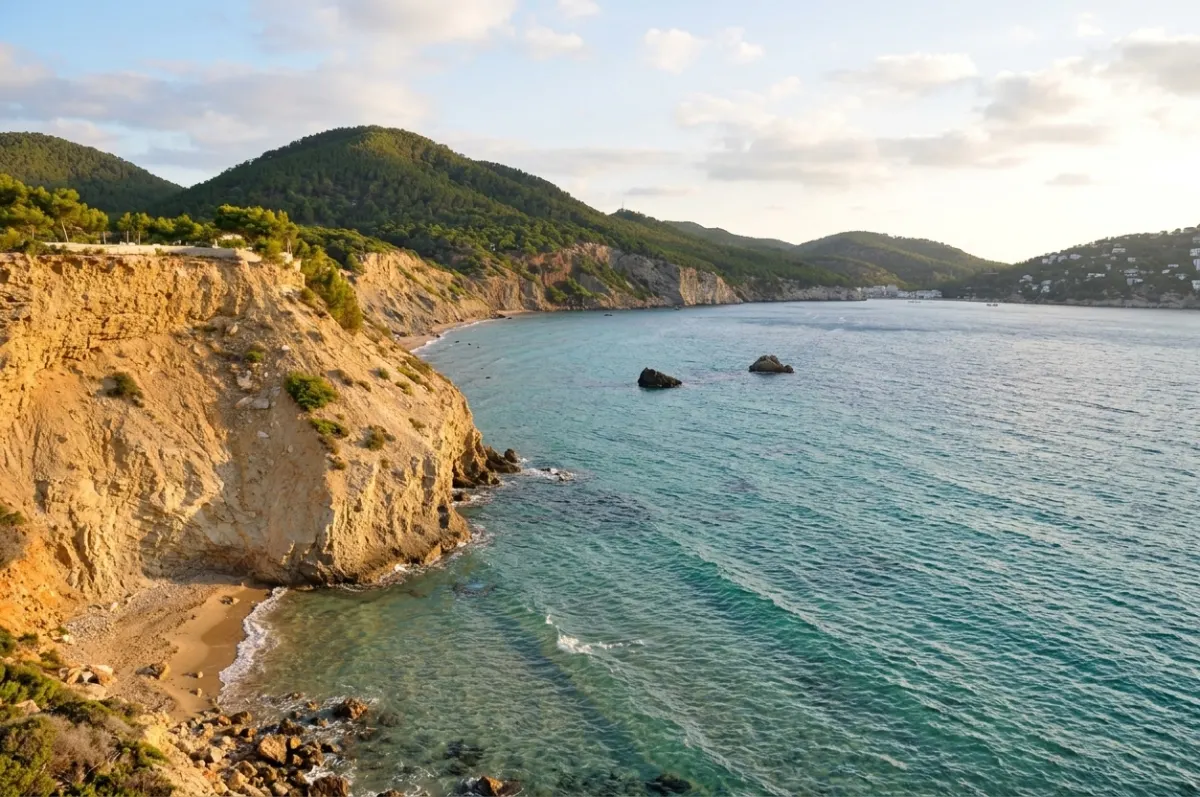
Racó de ses Dones: Ibiza’s Secluded Women’s Cove
OpenBoats
Racó de ses Dones is one of Ibiza’s smallest and most unusual hidden coves. Tucked away on the north-east coast near Es Figueral, this narrow stretch of shoreline has a story behind its name and an exceptionally difficult rocky approach. It is a place to appreciate Ibiza’s coastal history, not a conventional beach for a spontaneous swim.
Important update (October 2026): Es Paller d’en Camp, the distinctive rock monolith beside the cove, collapsed on 23 October 2026 following severe storms and years of erosion. Historic photographs and older descriptions of the narrow passage beside the rock may no longer reflect the terrain. We have not been able to verify a safe, currently usable route into Racó de ses Dones following the collapse.
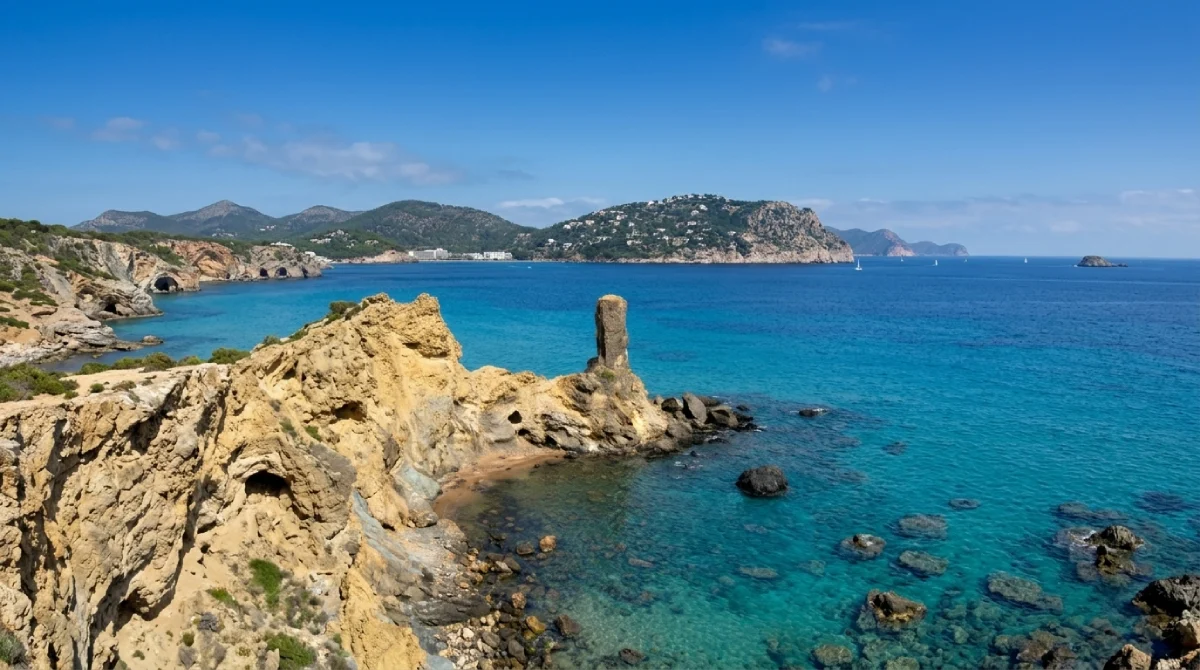
Es Paller d’en Camp monolith before the collapse
The Catalan name means «Women’s Corner». According to local accounts, women once used this secluded spot to bathe away from men. Today, that history, the dramatic shoreline and the recent change to its landscape make Racó de ses Dones an intriguing part of Ibiza’s story. In this guide, we’ll explain where it is, what happened to the famous rock and what to consider before exploring the area.
Racó de ses Dones at a glance
| Feature | What to know |
|---|---|
| Location | North-east Ibiza, municipality of Santa Eulària des Riu, between the Es Figueral and Aigües Blanques coastal areas |
| Other local name | Cova de ses Dones, a name associated with the former narrow rock passage |
| Landscape | Very small sandy and rocky inlet; the nearby monolith Es Paller d’en Camp collapsed in October 2026 |
| Approximate size | Historically described as around 20 metres of shore; the usable area may vary |
| Access | Previously described as a difficult route over rocks and through a narrow opening; safety and present-day access are unverified after the rockfall |
| Facilities | No conventional beach facilities to rely on |
| Best for | Learning about local history and viewing the wider coastline from safe, permitted places |
| By boat | Not a standard Open Boats stop or a guaranteed landing or anchoring location |
Where is Racó de ses Dones in Ibiza?
Racó de ses Dones lies on Ibiza’s north-east coast, within the municipality of Santa Eulària des Riu. It is near Es Figueral to the south and Aigües Blanques (Aguas Blancas) to the north. The area was long recognisable for the tall, isolated rock formation called Es Paller d’en Camp, which stood beside the neighbouring inlets until its collapse in October 2026.
The usual reference point for the wider area is Sant Carles de Peralta, from which roads lead towards Es Figueral. The official Balearic Islands tourism guide to Es Figueral describes an established beach reached by road. However, getting to Es Figueral does not mean that Racó de ses Dones can be reached safely. The hidden cove has a very different coastline and no straightforward public beach entrance.
Its proximity to Aigües Blanques is also misleading on a map: the two are not connected by a simple, maintained promenade along the shore.
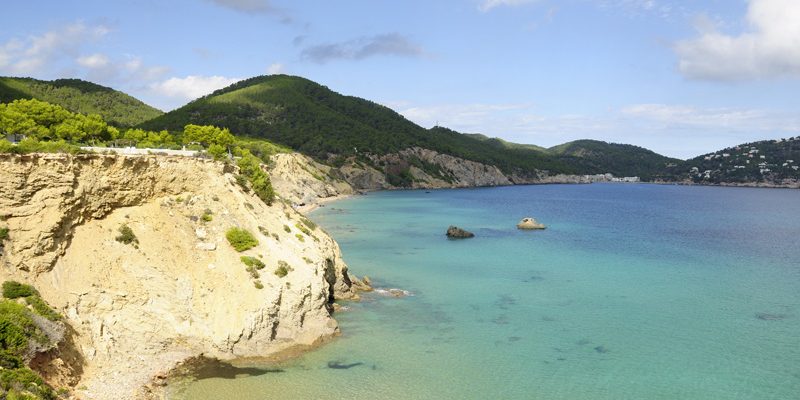
Why is it called the «Women’s Corner»?
Racó de ses Dones translates from Catalan as «Women’s Corner». According to local tradition, women used the secluded spot to bathe separately from men during the first half of the twentieth century, when attitudes towards bathing and privacy were very different from today’s.
The original Open Boats guide recalls how older women’s swimwear and the social expectations of the time made privacy especially important. The cove’s enclosed position offered a degree of discretion that more open beaches did not.
The story explains the historic name; Racó de ses Dones is not a women-only beach today. Another name found in local descriptions, Cova de ses Dones, refers to the small rocky opening traditionally associated with access to the cove. That historic description should not be taken as a current route recommendation.
What happened to Es Paller d’en Camp in 2026?
The famous rock formation collapsed
Es Paller d’en Camp was one of the most recognisable natural features of the Es Figueral coastline. This roughly 10-metre-high rock monolith once rose beside the small inlets near Racó de ses Dones. Its distinctive shape appeared in photographs and local accounts of the area for many years.
On 23 October 2026, the monolith collapsed after severe weather affected Ibiza. The collapse was reported the following day by local news outlets, including IB3’s coverage of Es Paller d’en Camp. The rock’s disappearance changed a familiar part of the island’s north-eastern coastal landscape.
What does the collapse mean for visitors?
Older photographs showing the monolith upright are now historical images. Equally importantly, guides that explain how to pass beneath or around the formation cannot be relied upon without a new on-site safety assessment. The collapse may have changed the rocky ground and access conditions, and further loose or unstable material may be present.
We have not confirmed whether the former opening still exists in a usable form or whether any lawful, safe route into Racó de ses Dones is available. Do not use pre-October 2026 route descriptions as step-by-step instructions, and never cross a rockfall area simply because an older map or photograph suggests a passage.
What makes Racó de ses Dones unusual?
A tiny cove rather than a developed beach
Historic local descriptions put the shore at approximately 20 metres, with a mixture of sand, stones and rocks. That is an indication of its small scale, not a promise of usable beach space on any particular day. Its setting is strikingly different from a broad sandy bay with easy access and visitor facilities.
The enclosure of the cove and its unusual history are what make it interesting. There are no ordinary beach amenities to plan around, and the surrounding rock makes moving around the shoreline more challenging than at Es Figueral.
Two neighbouring inlets with similar names
Racó d’es Paller d’en Camp is a separate small inlet on the Es Figueral side of the former monolith, while Racó de ses Dones is on the other side, towards Aigües Blanques. This distinction matters because older images and descriptions sometimes mix up the two places.
Some local guides also associate Racó d’es Paller d’en Camp with informal naturist bathing. That is not the same as saying Racó de ses Dones is officially designated for any particular group. After the 2026 collapse, the geography should also be assessed using up-to-date information rather than older landmark-based directions.
How do you get to Racó de ses Dones?
Es Figueral is a reference point, not a guaranteed route
Historically, visitors researching Racó de ses Dones started from Es Figueral. Older descriptions suggest walking towards its northern end, negotiating rocks and reaching the adjoining Racó d’es Paller d’en Camp before passing through an opening near the base of the monolith.
Those directions are no longer appropriate as a current access guide. Es Paller d’en Camp collapsed in October 2026, and we cannot verify that the historic passage is safe, open or even still practicable. Do not rely on old walking distances, estimated journey times or online route pins that have not been updated since the rockfall.
Do not attempt the former passage without verified local information
The approach was difficult even before the collapse. It involved uneven rocks and a narrow coastal opening, with hazards that could worsen during swell or after heavy rain. A recent rockfall adds another reason to avoid improvising a route.
Do not climb over fallen blocks, enter unstable openings or try to swim around exposed rocks to reach the cove. If local authorities have not confirmed a safe and permitted route, admire the coastline from a suitable viewpoint or choose an established beach instead.
Can you approach from Aigües Blanques?
Although Aigües Blanques is close to Racó de ses Dones geographically, the original Open Boats guide warns against treating it as a direct beach-to-beach access route. The cliffs and rocky shoreline make a casual walk between them unsuitable. The October 2026 events do not provide any reason to assume a new, safe connection exists.
Is Racó de ses Dones safe for swimming?
Clear Mediterranean water may look inviting, but water clarity does not indicate safe swimming conditions. Rocky shores can make entry and exit difficult, while easterly winds and swell can create unexpected hazards on this part of Ibiza’s coast.
Because current access conditions following the October 2026 collapse are unverified, we would not recommend planning Racó de ses Dones as a swimming destination. It is particularly unsuitable as an improvised family beach trip. Never swim around rocks to bypass a blocked or uncertain land approach.
For walks in the wider area, wear footwear with good grip, carry drinking water and sun protection, keep your phone charged and leave sufficient daylight for your return. Respect any restrictions or warning signs. In an emergency in the Balearic Islands, call 112.
Can you visit Racó de ses Dones by boat?
Boating can offer views of Ibiza’s striking north-eastern shoreline, but seeing a cove from the sea is not the same as being able to anchor, land or swim ashore safely. The coast is rocky, and the recent collapse makes it especially important not to assume that older navigation photographs show the current conditions.
At Open Boats, we operate from Sant Antoni de Portmany on Ibiza’s west coast. Racó de ses Dones lies on the north-east coast and is not a standard or guaranteed destination on our rental routes. Any longer itinerary towards this part of the island would depend on the chosen vessel, its permitted navigation area, the weather, fuel, time available and any skipper requirements.
For a realistic coastal plan, see our boat hire with a skipper in Ibiza or contact our team. We can help you choose a suitable experience rather than promise access to a cove that may not be safely reachable.
Anchoring and Posidonia oceanica
Boat visitors must also protect the seabed. Anchoring on living Posidonia oceanica seagrass is prohibited in the Balearic Islands, and some areas are subject to additional conservation or mooring rules. Before anchoring anywhere, check local navigation restrictions and ensure that neither the anchor nor its chain damages protected seagrass.
The Balearic Government’s Posidonia guidance provides information on the rules and official mapping. If you cannot identify a safe, legal stopping point, choose another location.
When is the best time to explore this part of Ibiza?
Spring and early autumn often offer more comfortable temperatures for walking than the height of summer. However, weather, sea conditions and the stability of the coastline matter far more than the season, especially following the October 2026 rockfall.
Choose daylight hours, check the forecast and stay on clearly permitted, safe ground. There is no reason to risk an unstable shoreline simply to tick a hidden cove off your list.
Other coves and beaches to explore nearby
If Racó de ses Dones cannot be visited safely, you can still enjoy the natural scenery of Ibiza’s north-east coast from more accessible places.
- Es Figueral: an established sandy beach reached by road from Sant Carles. Check conditions and any temporary access restrictions before visiting.
- Aigües Blanques: a picturesque beach known for its cliffs and naturist tradition. It is a separate destination, not an access route into Racó de ses Dones.
- Racó d’es Paller d’en Camp: the neighbouring inlet associated with the former rock formation. Do not treat it as an easy alternative after the collapse; the rocky access also requires current safety confirmation.
- Other quiet coves: see our guide to the best coves in Ibiza for other ideas around the island.
If you are travelling with children or would prefer easier beach access, start with our family-friendly beaches in Ibiza guide.
Frequently asked questions about Racó de ses Dones
Where is Racó de ses Dones in Ibiza?
Racó de ses Dones is a very small cove on Ibiza’s north-east coast, near Es Figueral and Aigües Blanques in the municipality of Santa Eulària des Riu.
Why is it called Racó de ses Dones?
The Catalan name means «Women’s Corner». Local accounts say women used the sheltered cove to bathe separately from men during the first half of the twentieth century.
What happened to Es Paller d’en Camp?
The famous rock monolith beside the cove collapsed on 23 October 2026, following severe storms and long-term erosion. Older photographs showing it standing no longer reflect the current landscape.
How do you get to Racó de ses Dones?
Older guides describe a difficult rocky approach from the Es Figueral area through an opening near Es Paller d’en Camp. After the October 2026 collapse, we cannot confirm that this route is safe or usable. Do not attempt it without up-to-date, reliable local access information.
Can you walk to Racó de ses Dones from Aigües Blanques?
There is no straightforward, established beach-to-beach path. The coastline is rocky and steep, so do not attempt to improvise a route between the two coves.
Is Racó de ses Dones suitable for children?
We would not recommend it as a family beach. The difficult and currently unverified access, rocky shoreline, lack of facilities and variable sea conditions make an established beach such as Es Figueral a more practical choice.
Does Racó de ses Dones have a beach bar or lifeguard?
No conventional beach bar, toilets, sunloungers or lifeguard service should be expected at this small, isolated cove.
Can you visit Racó de ses Dones by boat with Open Boats?
Racó de ses Dones is not a standard or guaranteed Open Boats stop. We operate from Sant Antoni on Ibiza’s west coast, and any route towards the north-east would depend on the boat, permitted navigation area, conditions and safe, legal stopping options.