Where to Find Ibiza’s Famous Natural Mud Baths
OpenBoats
Mud baths in Ibiza have long been one of the island’s more unusual beach experiences. For years, visitors have been drawn to coves where natural clay can be found in the surrounding cliffs, with some people applying the mud to their skin as part of a traditional beauty ritual.
Beaches such as Sa Caleta, Cala Xarraca and Aigües Blanques have become particularly well known for this practice. Their colourful clay-rich landscapes and crystal-clear Mediterranean waters have made them popular subjects for travel guides and photographs.
However, there is something important to know before planning a natural mud bath in Ibiza: some of these coastal areas have significant access restrictions and rockfall hazards. Taking clay from unstable cliffs can also damage the landscape, and the supposed health benefits of untreated natural mud are not established.
In this guide, we’ll explore Ibiza’s most famous mud-bath locations, explain their history, look at the claims surrounding clay treatments and share practical advice for enjoying these beautiful coastal landscapes responsibly.
What are Ibiza’s natural mud baths?
Natural mud bathing is a traditional practice in which clay or mineral-rich sediment is mixed with water and applied to the skin. The practice is associated with various coastal destinations and thermal spa traditions around the world.
In Ibiza, the custom became popular around beaches with clay-rich cliffs, particularly those with distinctive reddish or greyish rock formations.
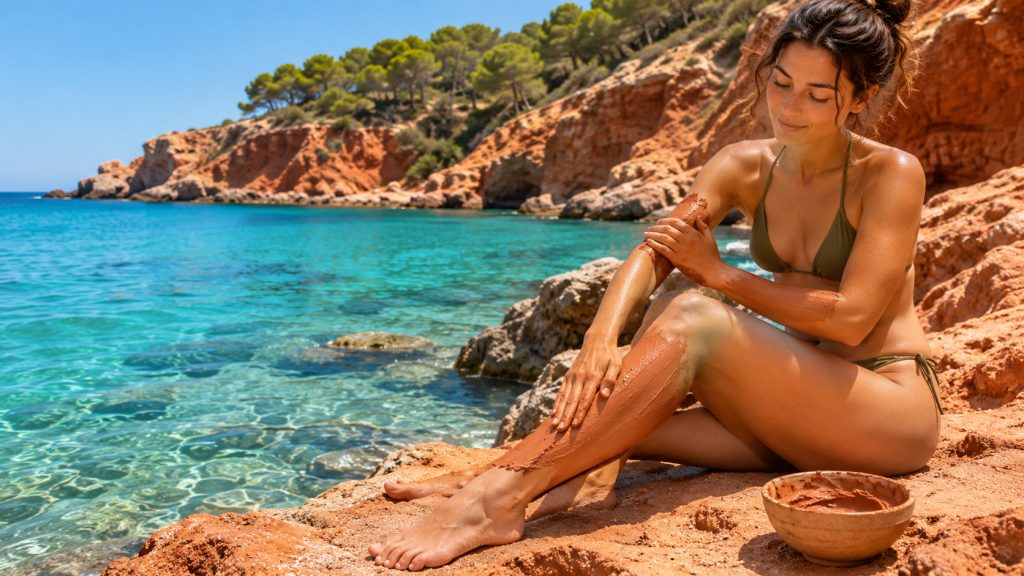
Visitors would traditionally mix small amounts of clay with water, spread the resulting paste over their skin and allow it to dry before washing it off.
Over time, the activity became a familiar part of Ibiza’s alternative beach culture, particularly among travellers looking for experiences beyond the island’s famous nightlife.
However, naturally occurring coastal clay is not the same as a tested cosmetic product or a professionally prepared spa treatment. Its composition, cleanliness and suitability for use on the skin are not necessarily known.
Do natural mud baths have health benefits?
Mud therapy, sometimes called pelotherapy, has been practised for centuries in different parts of the world. It is associated with spa treatments, relaxation and traditional approaches to skin care.
Supporters of natural mud baths often claim that clay can soften the skin, remove impurities, ease muscle tension or help with certain joint conditions.
However, these claims should not be confused with proven medical benefits from applying untreated clay collected from an Ibiza beach.
Can mud improve your skin?
Certain cosmetic clay preparations are used in skincare products because of their absorbent properties and their ability to remove surface oils.
However, the effects depend on the type of clay, its composition and how the product has been prepared and tested.
There is no reliable basis for assuming that clay taken directly from a coastal cliff in Ibiza will have the same properties or safety profile as a cosmetic product.
Untreated natural mud may contain microorganisms or other substances that could irritate the skin. It should not be applied to broken skin, open wounds or sensitive areas.
Can mud baths relieve arthritis or muscle pain?
Some controlled spa treatments involving mineral mud and heat have been studied for their possible effects on certain musculoskeletal conditions.
However, the results of these studies cannot automatically be applied to untreated clay found on Ibiza’s beaches.
There is insufficient evidence to recommend collecting and applying coastal mud as a treatment for arthritis, rheumatism or other medical conditions.
If you are interested in mud-based skincare or wellness treatments, a professionally managed spa using products intended for skin application is a more appropriate option.
Three famous mud-bath beaches in Ibiza
Historically, three places have been particularly associated with natural mud bathing in Ibiza: Sa Caleta (Es Bol Nou), Cala Xarraca and Aigües Blanques.
Each offers a different coastal landscape, but their current conditions and access arrangements must be considered before visiting.
1. Sa Caleta (Es Bol Nou): Ibiza’s famous red clay cliffs
Sa Caleta, also known as Es Bol Nou, is one of Ibiza’s best-known locations for traditional mud bathing. Situated on the southern coast in the municipality of Sant Josep de sa Talaia, the beach is surrounded by striking reddish-orange cliffs.
The distinctive colour comes from the geological composition of the surrounding terrain, which contains clay-rich materials.
For many years, visitors applied reddish mud from the cliffs to their skin, creating one of the island’s most recognisable beach rituals.
The original Open Boats guide describes how tourists would cover themselves in clay, allow it to dry and then enter the clear Mediterranean water to wash it off.
Important: Sa Caleta beach is closed because of rockfall risks
Sa Caleta (Es Bol Nou) has been closed to public access since April 2025 because of the danger of falling rocks from its unstable cliffs.
The closure remained in effect during 2026, with the local authorities warning that rockfalls could pose a serious risk to visitors.
Consequently, we do not recommend visiting Sa Caleta for mud bathing, entering the closed beach area or approaching the cliff walls to collect clay.
Respect all barriers, warning signs and official restrictions. Do not attempt to reach a closed section by walking around barriers or approaching it from the sea.
For current information, check the official Sant Josep tourism information for Es Bol Nou before planning any visit to the area.
The Phoenician settlement of Sa Caleta
Sa Caleta is also important for its archaeological heritage. Near the coastal area are the remains of a Phoenician settlement dating from the early history of Ibiza.
The archaeological site forms part of Ibiza’s UNESCO World Heritage designation and offers an insight into the island’s ancient Mediterranean connections.
The historic attraction and the closed beach are separate considerations. Before visiting the archaeological area, check the current access arrangements and follow any restrictions affecting the surrounding coastline.
2. Cala Xarraca: the famous natural mud-bath cove
Cala Xarraca is one of the best-known beaches associated with natural mud baths in northern Ibiza. Located in the municipality of Sant Joan de Labritja, not far from Portinatx, it is particularly popular for its clear water and rocky coastal scenery.
The cove combines a small beach, traditional fishermen’s jetties and beautiful Mediterranean views.
Its generally transparent water also makes it attractive to visitors interested in swimming and snorkelling when conditions are suitable.
Where were the mud baths traditionally found?
Older travel guides describe an area towards the left-hand side of Cala Xarraca, beyond the main beach, where visitors traditionally collected clay from the surrounding rock formations.
This more secluded part of the coastline has also been associated with informal naturist bathing.
However, the existence of a traditional mud-bathing area does not mean that collecting clay is currently permitted or that the surrounding cliffs are safe to approach.
Climbing over rocks or scraping clay from coastal walls can expose visitors to falls, unstable ground and possible rockfalls.
We recommend enjoying Cala Xarraca for its natural beauty rather than extracting clay from the cliffs.
What else can you do at Cala Xarraca?
There are plenty of reasons to appreciate this northern cove without taking part in mud bathing.
- Snorkelling: the rocky seabed can provide interesting underwater scenery when the water is calm.
- Swimming: enjoy the Mediterranean in suitable conditions, keeping clear of hazardous rocks and other vessels.
- Coastal photography: capture the contrast between the turquoise water, rocky coastline and Mediterranean vegetation.
- Traditional maritime heritage: admire the small fishermen’s jetties and their place in Ibiza’s coastal history.
- Exploring northern Ibiza: combine a visit with other suitable beaches around Portinatx and Sant Joan.
For more information about the location, see the official Balearic Islands guide to Cala Xarraca.
3. Aigües Blanques: grey clay and a dramatic northern coastline
Aigües Blanques, also known as Aguas Blancas or s’Aigua Blanca, is another beach traditionally associated with natural mud bathing in Ibiza.
Located on the north-eastern coast in the municipality of Santa Eulària des Riu, near Sant Carles de Peralta, the beach is known for its impressive cliffs, golden sand and clear Mediterranean water.
It has also been a popular destination among naturists, particularly because of its relatively secluded coastal setting.
Unlike the reddish clay associated with Sa Caleta, the material found in the cliffs around Aigües Blanques is often described as greyish in colour.
Historically, some visitors mixed this clay with water and applied it to their skin, sometimes claiming that it had beneficial properties.
Important access and safety information for Aigües Blanques
Aigües Blanques has experienced significant restrictions because of instability in the surrounding cliffs.
In June 2026, Santa Eulària des Riu Town Council confirmed that the beach would operate without municipal lifeguard services or other municipal beach services.
The local authority also confirmed that road access would remain closed to vehicles and specifically warned visitors not to remain beneath dangerous cliff slopes or ignore rockfall warning signs.
These restrictions do not necessarily mean that every pedestrian approach is prohibited, but visitors should not assume that all access routes are available or safe.
Before visiting, check the latest local guidance, respect all notices and avoid areas affected by erosion or unstable rock.
Do not scrape clay from the cliffs or approach hazardous sections of the beach to collect mud.
You can consult the official Santa Eulària Town Council notice about Aigües Blanques.
Is it safe to collect natural clay from Ibiza’s cliffs?
Collecting natural clay directly from coastal cliffs is not something we recommend.
Although mud bathing has been popular for decades, Ibiza’s coastal cliffs are dynamic geological formations affected by rain, wind, waves and erosion.
Removing material from cliff walls may contribute to localised degradation, while standing directly beneath an unstable slope can expose visitors to serious hazards.
Some of Ibiza’s beaches have already experienced major rockfalls and temporary or prolonged access restrictions.
There are also potential skin-related risks associated with using untreated natural materials.
Before considering any traditional mud-bathing activity, remember:
- Check local restrictions: not every beach or coastal area permits the same activities.
- Do not remove clay from cliffs: avoid disturbing unstable rock and natural formations.
- Never enter closed areas: barriers and warning signs must be respected, even when other visitors ignore them.
- Do not use untreated mud as a medical treatment: its safety and composition are not guaranteed.
- Protect the environment: do not remove sediments, damage coastal vegetation or leave waste behind.
- Consider safer alternatives: professionally prepared cosmetic clay products can provide a similar spa-style experience without disturbing the shoreline.
Remember that a photograph shared on social media does not establish whether an activity is safe or permitted.
Are mud baths prohibited in protected areas of Ibiza and Formentera?
Some protected areas have explicit restrictions on collecting or using natural mud and clay.
For example, the regulations governing the Ses Salines d’Eivissa i Formentera Natural Park prohibit bathing in and using clay from the protected salt lagoons.
This rule is particularly relevant to visitors who have heard about traditional mud bathing in the wider Ibiza and Formentera area, including stories associated with the protected island of s’Espalmador.
These environments support important wildlife and delicate natural habitats. Disturbing their sediments can affect the ecosystem and may lead to penalties.
The rules for salt lagoons should not automatically be confused with those governing every beach on Ibiza, but they illustrate why natural mud cannot be treated as a freely available resource wherever it is found.
For information about the protected area, visit the Balearic Government’s Ses Salines Natural Park information.
What is the best time to visit Ibiza’s mud-bath beaches?
If you are interested in the coastal landscapes traditionally associated with mud bathing, late spring, summer and early autumn can offer pleasant weather for exploring Ibiza.
However, the season does not guarantee safe conditions.
Strong winds, rain and wave action can increase coastal erosion and rockfall hazards. This is especially important around beaches surrounded by high cliffs.
Before travelling, check the local weather forecast, beach access restrictions and any current safety notices.
It is also worth remembering that some northern and eastern beaches can be exposed to swell even when other parts of Ibiza appear calm.
Safety and access conditions should always take priority over the time of year.
Quiet places in Ibiza to explore instead
Ibiza has plenty of beautiful coastal locations where you can enjoy nature without collecting clay or approaching unstable cliffs.
If you are exploring the northern part of the island, consider the following alternatives, subject to current weather and access conditions.
Cala Xuclar
Located near Portinatx, Cala Xuclar is a small cove surrounded by Mediterranean vegetation and rocky coastal scenery.
Its natural setting makes it attractive to visitors looking for a quieter corner of northern Ibiza.
The beach is a separate destination from Cala Xarraca, so check its access and facilities before visiting.
Cala Sant Vicent
Cala Sant Vicent is a wider sandy beach on Ibiza’s north-eastern coastline, with impressive views towards the island of Tagomago.
It offers a different type of beach experience from the more secluded coves, with a larger shoreline and services in the surrounding area.
It can be a more practical choice for travellers who prefer an established beach rather than an isolated location beneath unstable cliffs.
Other coves around Ibiza
If you would like to discover more coastal scenery, explore our guide to the best coves in Ibiza.
For visitors interested in underwater landscapes, our guide to Ibiza’s best snorkelling spots offers additional ideas.
Whatever your destination, always choose a location appropriate for the weather, your abilities and any current access restrictions.
Can you visit Ibiza’s mud-bath beaches by boat?
Some of the coastal locations traditionally associated with mud bathing can be admired from the sea, but that does not mean they are all suitable or legally accessible by rental boat.
Sa Caleta, Cala Xarraca and Aigües Blanques are situated on different sections of Ibiza’s coastline. They do not form a short, straightforward route from Sant Antoni de Portmany.
In addition, beach closures and rockfall warnings must be respected. Approaching a restricted beach by sea does not automatically give visitors permission to land or enter a closed area.
At Open Boats, we operate from Sant Antoni de Portmany on Ibiza’s west coast. Our rental experiences focus on routes suitable for the chosen boat, its authorised navigation area and the prevailing sea conditions.
We do not present visits to mud-bathing locations as a standard part of our rental service, and we do not recommend approaching unstable cliffs to collect clay.
If your priority is to discover Ibiza’s spectacular coastline by sea, we can help you explore suitable alternatives along the western coast.
For a personalised experience, discover our boat hire with a skipper in Ibiza or contact our team to discuss your plans.
Frequently asked questions about mud baths in Ibiza
Where can you find natural mud baths in Ibiza?
Sa Caleta (Es Bol Nou), Cala Xarraca and Aigües Blanques are the three beaches most commonly associated with traditional natural mud bathing in Ibiza. However, access restrictions, rockfall hazards and environmental rules mean that visitors should not assume mud collection or bathing is permitted at these locations.
Is Sa Caleta open for mud baths?
No. Sa Caleta (Es Bol Nou) has been closed to public access since April 2025 because of the risk of falling rocks. The closure remained in effect during 2026. Do not enter the restricted area or approach the cliffs to collect clay.
Can you take a mud bath at Cala Xarraca?
Cala Xarraca is historically known for natural mud bathing, particularly around a more secluded section of the cove. However, we do not recommend removing clay from the surrounding cliffs. Check current restrictions and avoid unstable rocks or hazardous coastal areas.
Is Aigües Blanques beach open to visitors?
Access arrangements have changed because of rockfall risks. In June 2026, the local council confirmed the closure of road access to vehicles and the absence of municipal lifeguard and beach services. Check the latest official guidance before visiting and avoid dangerous cliff areas.
Are Ibiza’s natural mud baths good for your skin?
Some cosmetic clay preparations have recognised skincare uses, but that does not establish the safety or benefits of untreated clay collected from Ibiza’s beaches. Claims that local mud treats arthritis, rheumatism or other medical conditions are not supported by sufficient specific evidence.
Are natural mud baths banned in Ibiza?
There is no single rule establishing an identical prohibition on all mud-related activities at every beach. However, some locations are closed because of safety hazards, and protected environments such as the Ses Salines salt lagoons have explicit restrictions on bathing and clay use. Always check the rules for the specific location.
Can you visit mud-bath beaches with Open Boats?
Open Boats operates from Sant Antoni de Portmany on Ibiza’s west coast. Sa Caleta, Cala Xarraca and Aigües Blanques are not standard mud-bathing stops on our rental routes. Any appropriate coastal itinerary depends on the boat, navigation permissions, weather and local restrictions.