Ses Balandres in Ibiza: A Guide to This Hidden Cove
OpenBoats
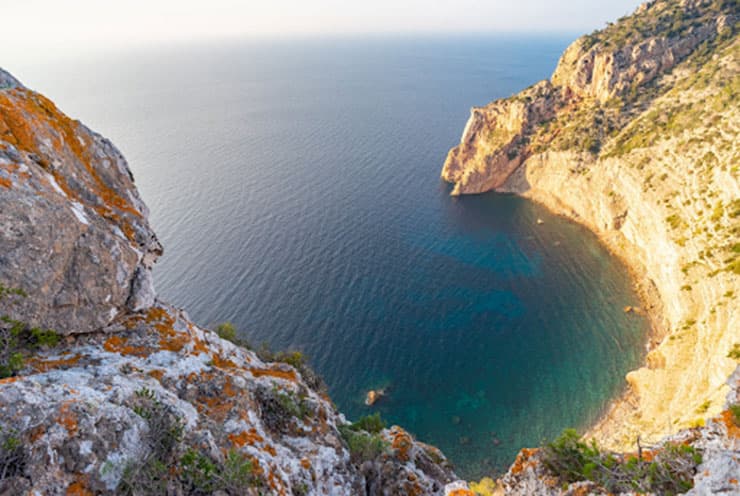
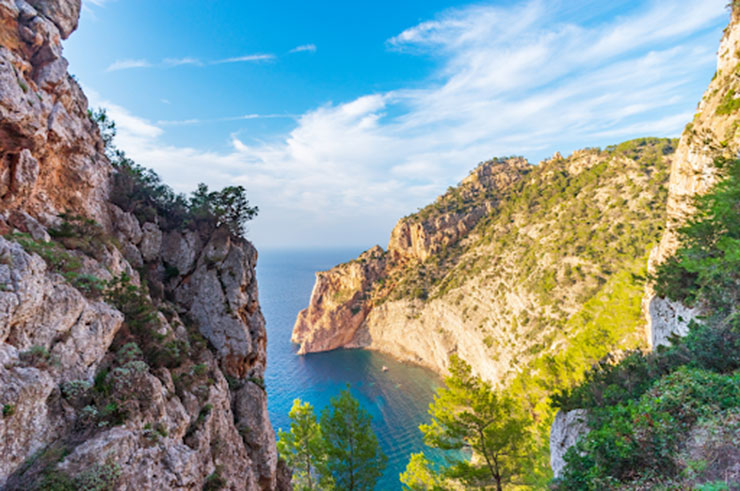
On the rugged north-west coast of Ibiza, Ses Balandres is a secluded cove beneath towering cliffs near Santa Agnès de Corona. Its clear water, rocky shoreline, traditional fishermen’s huts and views towards the Ses Margalides islets make it one of the island’s most striking coastal landscapes.
Yet this is not an ordinary beach outing. The land route to Ses Balandres is a demanding cliff descent involving exposed rocky sections, ropes and wooden ladders. It is unsuitable for casual walkers, and conditions can make the descent unsafe. The cove can also be admired from the sea, although approaching the shore or disembarking is not always possible.
In this guide, we explain where Ses Balandres is, what the original walking route involves, what makes the area special and how to enjoy this part of Ibiza responsibly.
Ses Balandres at a glance
- Location: north-west Ibiza, below the cliffs near Santa Agnès de Corona, in the municipality of Sant Antoni de Portmany.
- Beach: a narrow, rugged shore of pebbles, gravel and rocks rather than a sandy beach.
- Land access: a difficult, exposed descent; not a standard signposted beach path.
- Facilities: do not expect lifeguards, toilets, shops or beach restaurants at the cove.
- Main attractions: dramatic scenery, traditional fishing huts and views across to Ses Margalides.
- Alternative: admire the coast from appropriate viewpoints or, when conditions and the chosen vessel permit, from a suitably planned boat trip.
Where is Ses Balandres in Ibiza?
Ses Balandres lies beneath the cliffs of Es Amunts, a mountainous coastal landscape in the north-west of Ibiza. The nearest village is Santa Agnès de Corona (also known as Santa Inés), inland from Sant Antoni de Portmany. Despite being relatively close to Sant Antoni as the crow flies, the shoreline is remote and access is far more complicated than the map might suggest.
The rural setting is part of the experience. Around Santa Agnès, you will find traditional whitewashed houses, dry-stone walls, pine woodland and the agricultural landscape of Pla de Corona, known for its almond trees. The contrast between this peaceful countryside and the cliffs above the Mediterranean is remarkable.
Ses Balandres is sometimes called Cala de Ses Balandres. Both names refer to the same coastal area, not a large resort beach.
How to get to Ses Balandres on foot
The traditional approach starts in the Santa Agnès area. The original Open Boats guide describes following Camí des Pla de Corona towards an old well, then continuing past rural houses and pine trees until the terrain opens out above the cliffs.
That description can help you identify the general area, but it must not be treated as a safe, turn-by-turn hiking route. Access points, tracks and their condition may change. Check current local information and any closures or restrictions before setting out, and never cross private property or barriers without permission.
Why is the Ses Balandres hike so difficult?
The challenge begins at the cliff. The route becomes narrow and exposed, with steep, uneven ground, loose stones and sections where fishermen historically installed ropes, handrails and wooden ladders to reach the shore.
These installations should not be mistaken for a professionally maintained adventure course. Their condition cannot be guaranteed, and a slip could have serious consequences. The local coastline has been identified as a hazardous area for walkers because of the height of the cliffs, unstable rock and difficult terrain.
Our recommendation: do not attempt the descent as an ordinary holiday walk. If you are considering it, seek up-to-date advice from a suitably qualified local mountain or hiking professional. Turn back whenever the route or conditions are uncertain; do not rely on ropes or ladders simply because they are present.
How long does it take to reach the cove?
The original Spanish guide gives roughly 30 minutes for the descent and 45 minutes for the climb back. These are historical estimates, not dependable timings for a visitor today. The actual time depends on fitness, experience, conditions and the route’s current state. The return climb is particularly demanding in hot weather.
Allow plenty of time if exploring the wider Santa Agnès area, and remember that a short distance on a map does not mean easy access.
Safety advice before visiting Ses Balandres
The scenery may look inviting in photographs, but this is an isolated stretch of coast without the facilities you would expect at a managed beach. Plan conservatively.
- Do not underestimate the cliffs. Avoid exposed edges, unstable rocks and any descent you cannot reverse safely.
- Do not rely on existing ropes or ladders. Their presence is not evidence that they are inspected, maintained or safe to use.
- Take weather and heat seriously. Rain, strong winds, swell and hot conditions can make the trip more hazardous.
- Carry essentials. For any walk in the area, bring adequate drinking water, food, sun protection, appropriate footwear and a charged phone.
- Assume limited phone reception. Tell someone where you plan to go and when you expect to return.
- Avoid the descent with children or anyone uncomfortable with heights or steep terrain. There are safer ways to appreciate Ibiza’s coast.
- Respect access restrictions. If signs indicate a closure or danger, do not proceed.
If a serious accident occurs, call 112, the emergency number used in the Balearic Islands, where you have a signal. Do not put yourself or others at further risk trying to reach someone on unstable terrain.
What makes Ses Balandres so special?
A raw coastline of cliffs and clear water
Unlike Ibiza’s broad sandy beaches, Ses Balandres is defined by steep rock faces, a pebbly shore and the changing colours of the Mediterranean. The towering cliffs create a sense of scale that is difficult to capture in a photograph. The sea may appear transparent from above, but water conditions can change quickly when swell reaches this exposed coastline.
Traditional fishermen’s huts
At the foot of the cliffs are casetas varadero, traditional stone or timber structures used by local fishermen to shelter boats and equipment. They are an important part of Ibiza’s maritime heritage and a reminder of how demanding life on this coastline once was.
These are not visitor facilities. Observe them respectfully and do not enter, climb on or disturb the buildings and equipment.
Views towards Ses Margalides
Looking out to sea, you can see Ses Margalides, the striking rocky islets off Ibiza’s north-west coast. Their shapes, including a natural arch on the larger islet, are among the area’s most memorable features.
They can be appreciated from the coastline or from a boat at an appropriate distance. Passing close to or through a natural arch should never be treated as a standard tourist manoeuvre: sea state, clearance, protected habitats and the skipper’s judgement determine what is safe and permitted.
Can you visit Ses Balandres by boat?
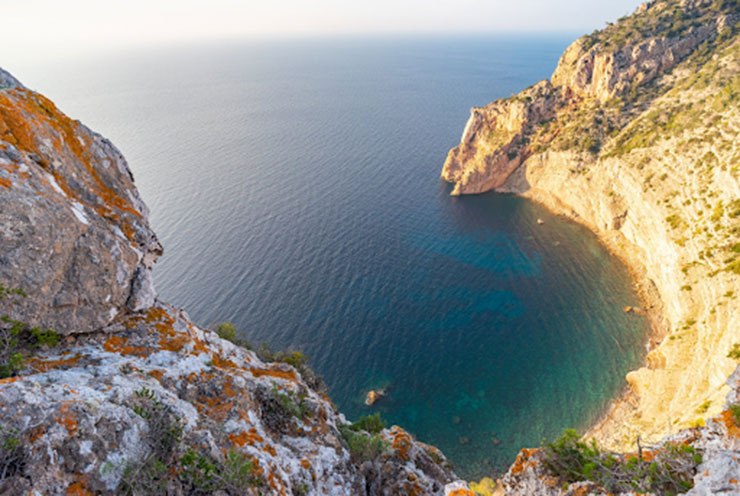
Yes, the Ses Balandres coastline can be viewed from the sea, and for many visitors this is a more appealing way to appreciate the cliffs than attempting the difficult walk. A trip along Ibiza’s north-west coast can offer views of the rocky shore, fishermen’s huts and the nearby islets without requiring a cliff descent.
There is an important distinction, however, between seeing Ses Balandres from a boat and landing at Ses Balandres. This is not a conventional marina or beach with a guaranteed landing point. Swell, depth, rocks, wind, environmental restrictions and the boat’s characteristics may make close approaches, anchoring or disembarkation unsuitable or impossible.
Open Boats operates from Sant Antoni de Portmany, and its team has experience navigating the coast of Ibiza and Formentera. If this section of coast interests you, ask about a private boat hire experience in Ibiza and whether a suitably skippered itinerary may include distant views of the Ses Balandres area. Do not assume this destination is included in every hire or that landing is available. The final route always depends on the vessel, weather, safety and the operator’s confirmation.
To discuss a suitable plan, contact Open Boats before booking. A good coastal itinerary should adapt to conditions rather than promise access to a particular remote cove.
Can you swim or snorkel at Ses Balandres?
The clear water and rocky seabed may look appealing, but Ses Balandres is not a supervised swimming beach. There are no lifeguards or usual beach services, and entering or leaving the water may be difficult depending on swell and conditions. Rocks, changing depth and currents can all create risks.
Do not assume the sea is safe simply because it looks calm from a viewpoint. If you are on a boat, swimming should take place only where the skipper judges it safe and where local rules allow it. There is no need to swim at Ses Balandres itself to enjoy the scenery.
What else can you see near Ses Balandres?
Santa Agnès de Corona and Pla de Corona
The village of Santa Agnès is an appealing stop in its own right. Its quiet streets, traditional church and surrounding farmland offer a different side of Ibiza from the island’s busier seaside resorts. Pla de Corona is particularly attractive during the almond blossom season, although flowering dates vary with the weather.
Sa Penya Esbarrada, also known as the Gates of Heaven
In the wider Santa Agnès area, Sa Penya Esbarrada is known for its coastal views and sunsets. The landscape provides an opportunity to enjoy the north-western cliffs without descending to the shore. Keep well away from unprotected edges and use permitted, established access routes.
For more context on the area’s rural landscape and viewpoints, see the official Sant Antoni tourism guide to Pla de Corona.
When is the best time to visit the Ses Balandres area?
There is no universally safe season for the cliff descent. A dry day with mild temperatures may be more comfortable for exploring established paths around Santa Agnès, but weather alone does not remove the risks of the route down to Ses Balandres.
In summer, heat makes the uphill return more demanding. After rain, loose or slippery ground may become especially hazardous. If travelling by sea, wind and swell are more important than whether the calendar says spring, summer or autumn.
For most travellers, the best plan is to choose an accessible viewpoint or a professionally planned coastal trip, then remain flexible about the exact itinerary.
How to explore Ses Balandres responsibly
The appeal of Ses Balandres comes from its natural and cultural character. Keeping it that way matters as much as getting a good photograph.
- Take all rubbish away and leave fishing huts, dry-stone walls and traditional structures untouched.
- Stay on authorised paths and respect local access restrictions.
- Do not approach nesting wildlife or disturb the landscape for photographs.
- Avoid loud music and unnecessary disturbance in this quiet coastal environment.
- When boating, respect protected marine habitats and do not anchor on Posidonia oceanica seagrass meadows.
The Balearic Islands maintain official rules protecting Posidonia seagrass and regulating anchoring. A responsible skipper will consider the seabed, local restrictions and the conditions before deciding whether a stop is possible.
Frequently asked questions about Ses Balandres, Ibiza
Where is Ses Balandres?
Ses Balandres is on Ibiza’s north-west coast, below the cliffs near Santa Agnès de Corona in the municipality of Sant Antoni de Portmany.
Is Ses Balandres easy to reach on foot?
No. The traditional route involves a steep, exposed cliff descent with ropes and wooden ladders. It is not a normal beach path and should not be attempted casually.
How long is the hike to Ses Balandres?
The original local guide suggests approximately 30 minutes down and 45 minutes back up, but these are only rough historical estimates. Conditions and individual ability can change the time considerably. The descent itself may be unsafe.
Can I visit Ses Balandres with children?
We do not recommend the cliff descent for children or for visitors with limited mobility, vertigo or little experience on exposed terrain. The nearby countryside and accessible viewpoints are more suitable alternatives.
Can I get to Ses Balandres by boat from San Antonio?
The coastline can be viewed by boat when weather, sea conditions and the chosen vessel permit. A trip from Sant Antoni must be planned with an appropriate operator or skipper. Landing or swimming at the cove is not guaranteed.
Does Ses Balandres have restaurants or beach facilities?
No. Do not expect a beach bar, toilets, sunbed hire or lifeguard services at Ses Balandres. The fishermen’s huts are part of the area’s maritime heritage, not tourist facilities.
Is Ses Balandres worth visiting?
Its cliffs, traditional fishing huts and views of Ses Margalides make it a remarkable part of Ibiza. For most visitors, the best experience is to admire the landscape from a safe viewpoint or from the sea rather than attempt the hazardous descent.
Discover the quieter side of Ibiza with Open Boats
Ses Balandres shows why Ibiza’s coastline deserves to be explored with care: some of its most beautiful places are also among the most difficult to reach. You do not have to take unnecessary risks to appreciate that scenery.
At Open Boats, we know the importance of matching each itinerary to the boat, the conditions and the people on board. If you would like to explore Ibiza’s coast from Sant Antoni, tell us what kind of boat day you have in mind and we can discuss the options that are suitable for your booking.