Cala Aubarca: Ibiza’s Hidden Northern Cove
OpenBoats
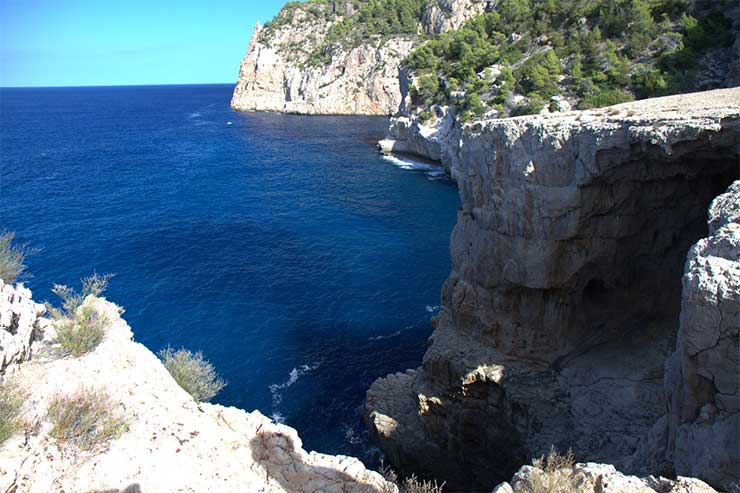
Cala Aubarca is one of Ibiza’s most remarkable hidden coves. Also known as Cala d’Albarca or Cala d’Albarcar, this secluded inlet on the island’s northern coast combines dramatic cliffs, pine forests, clear Mediterranean water and one of Ibiza’s most striking natural landmarks: a spectacular stone bridge formed by erosion.
Far from the busy beaches and beach clubs, Cala Aubarca offers a different side of Ibiza. It is a place for hikers, nature lovers and visitors who appreciate wild coastal landscapes. However, reaching the cove requires effort, and its rocky shoreline is not suitable for everyone.
In this guide, we’ll explain where Cala Aubarca is, how to reach it from Sant Mateu, what makes its natural stone bridge so special and what you should know before planning a visit.
Where is Cala Aubarca in Ibiza?
Cala Aubarca is located on the northern coast of Ibiza, in the municipality of Sant Antoni de Portmany, around 15 kilometres from the town of Sant Antoni. The nearest inland village is Sant Mateu d’Albarca, a small rural settlement surrounded by agricultural land, hills and traditional Ibizan countryside.
The cove forms part of the spectacular Es Amunts landscape, an extensive area of mountains, pine forests, cliffs and remote coastal inlets in northern Ibiza.
Unlike the island’s more accessible beaches, Cala Aubarca has no developed seafront, large sandy beach or conventional tourist facilities. Its natural setting is the main attraction.
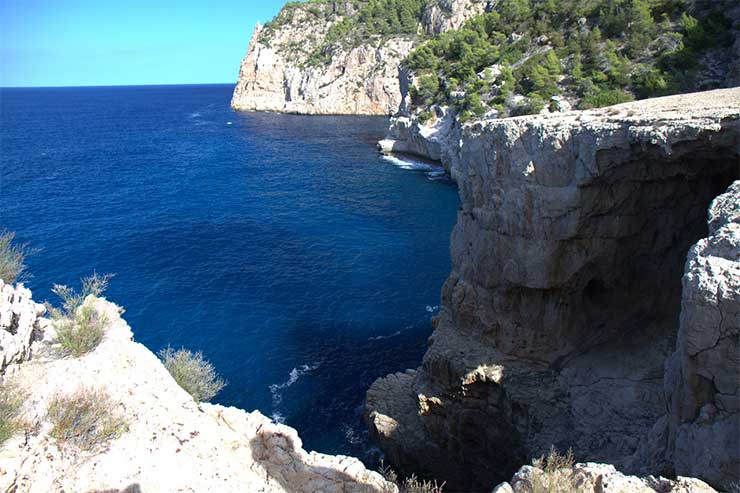
The surrounding cliffs rise dramatically above the Mediterranean, while the coastline features rocky platforms, small caves and areas of transparent water. Erosion and rockfalls have altered the shoreline over time, leaving relatively little space for conventional sunbathing.
The natural stone bridge of Cala Aubarca
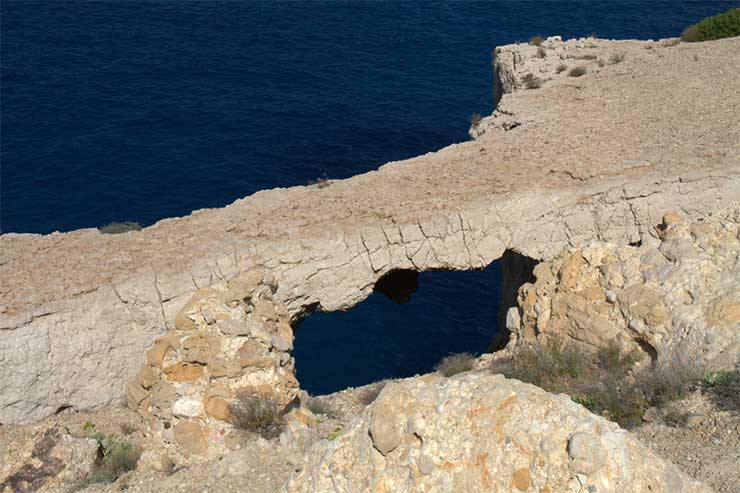
One of the main reasons people visit Cala Aubarca is its famous natural stone bridge, often called the Puente de Piedra or Stone Bridge of Cala Aubarca.
This impressive limestone formation stretches across a gap in the rocky coastline, creating a natural arch high above the sea. Over thousands of years, geological processes and erosion have shaped the rock into one of the area’s most recognisable features.
Is it safe to walk across the stone bridge?
Although the natural bridge is a popular subject for photographs, we do not recommend walking across it or approaching exposed edges. The formation stands above a significant drop, and the surrounding terrain is affected by natural erosion and weathering.
Older descriptions sometimes suggest that the bridge is wide enough to cross. However, this does not guarantee its structural condition or visitor safety. A slip, loose rock or unexpected loss of balance could have serious consequences.
The safest approach is to appreciate the arch from a suitable viewpoint on stable, permitted ground, without climbing onto the formation or attempting dangerous photographs.
What makes Cala Aubarca special?
Wild cliffs and turquoise Mediterranean water
Cala Aubarca is surrounded by impressive cliffs, some reaching around 200 metres in height in the wider coastal landscape. Pine forests, Mediterranean scrub and reddish rock formations create a striking contrast with the blue water below.
The sea can appear wonderfully clear when conditions are calm, with rocky underwater scenery and small marine caves adding to the character of the area.
However, Cala Aubarca is not a sheltered, easily accessible swimming beach. Its northern exposure means waves and swell can make entering or leaving the water difficult, particularly near the rocks.
Natural erosion has also reduced the amount of usable shoreline. Visitors should not expect a large sandy beach or a comfortable place to spend the entire day sunbathing.
Wildlife in Es Amunts
The natural surroundings of Cala Aubarca are also interesting for birdwatching and wildlife observation. The cliffs and coastal habitats of Es Amunts support various seabirds and birds of prey.
Depending on the season, visitors exploring the wider area may encounter gulls, cormorants, peregrine falcons and Eleonora’s falcons, a migratory species associated with Mediterranean coastal cliffs.
Keep a respectful distance from wildlife, avoid disturbing nesting sites and stay on established paths wherever possible.
How to get to Cala Aubarca from Sant Mateu
The usual land approach to Cala Aubarca begins in the area of Sant Mateu d’Albarca. The original Open Boats guide describes travelling north from the village, taking a rural track and leaving the vehicle before continuing downhill on foot.
Although older descriptions provide specific junctions and parking distances, rural tracks, parking permissions and access conditions can change. For that reason, do not rely on an old description alone to navigate the final approach.
- Travel towards Sant Mateu d’Albarca, in the rural north-west of Ibiza.
- Locate a current, permitted access route towards Cala Aubarca using reliable local information and an up-to-date walking map.
- Leave your vehicle only where parking is allowed, without blocking rural tracks, private properties or emergency access.
- Continue on foot along the descending route towards the coastline, checking the condition of the path as you go.
- Turn back if the terrain becomes unsafe, especially near steep cliffs, unstable rocks or exposed sections of the path.
How long does the walk take?
The original Open Boats article suggests approximately 30 to 40 minutes for the descent, but this should be treated as an estimate rather than a guaranteed walking time.
The duration depends on where you start, the route selected, your fitness and the condition of the terrain. Some hiking itineraries include additional sections towards the stone bridge or other coastal viewpoints and take considerably longer.
The return is uphill and generally more demanding than the descent. Allow plenty of time and drinking water for the climb back.
Is the Cala Aubarca hike difficult?
The route should be treated as a moderately demanding coastal hike, with loose stones, uneven ground and considerable changes in elevation. Certain sections may require greater experience, depending on the route chosen.
It is not an appropriate walk for visitors looking for an easy beach stroll. We would also discourage attempting unfamiliar sections alone, in extreme heat or during unsuitable weather.
Wear proper walking shoes with good grip and download your route before setting off, as mobile reception may be unreliable in remote areas.
Can you swim or snorkel at Cala Aubarca?
The transparent water and rocky seabed can make Cala Aubarca attractive to experienced swimmers and snorkellers when conditions are exceptionally calm. The surrounding marine environment includes submerged rocks, underwater formations and areas of marine vegetation.
However, swimming here requires considerable caution. The shoreline is rocky, access to the water may be difficult and the cove is exposed to winds and swell from the northern sector.
There is no lifeguard service, and entering the water may be unsafe even on a sunny day. Do not attempt to swim into sea caves, approach cliffs from the water or explore underwater passages without appropriate professional guidance.
If you want a more accessible experience, our guide to the best snorkelling spots in Ibiza covers other possibilities around the island.
Rock climbing at Cala Aubarca
Beyond hiking and coastal photography, the Cala Aubarca area is also known among rock climbers.
The cliffs around Punta Aubarca offer climbing routes in a spectacular natural setting. The original Open Boats guide describes numerous routes on rock faces reaching several dozen metres in height, with different technical difficulty levels.
However, this is not an activity to improvise during a casual visit. Climbing requires suitable experience, equipment, route information and an assessment of rock conditions.
Rockfalls and coastal erosion are genuine hazards in this part of Ibiza. Route descriptions, anchor conditions and access permissions should be checked through current climbing resources or experienced local guides.
Do not assume that a route described in an older guide remains safe or suitable today.
Secret places in Ibiza near Cala Aubarca
The area around Cala Aubarca has much more to offer than the stone bridge itself. If you enjoy discovering Ibiza’s quieter landscapes, consider these nearby places as separate excursions.
Sant Mateu d’Albarca
This small inland village is surrounded by vineyards, traditional farmland and rolling hills. It provides a peaceful introduction to the rural character of northern Ibiza and is a useful reference point before exploring the Cala Aubarca area.
Ses Torres d’en Lluc
In the wider Mola d’Albarca area, you can find the remains of Ses Torres d’en Lluc, an unusual fortified complex consisting of two towers and sections of wall.
The original Open Boats article associates the ruins with the island’s historic defence against pirate attacks. However, the site’s precise age and original purpose remain subjects of archaeological investigation, so it should not be presented as a definitively dated pirate fortress.
The location is a reminder of the long and sometimes mysterious history of Ibiza’s remote north-western coastline. Any visit should respect archaeological remains, access restrictions and the surrounding terrain.
Na Coloms, the Cave of Light
Further along Ibiza’s northern coastline lies Na Coloms, commonly known as the Cave of Light or Cueva de la Luz. This remarkable sea cave is known for the sunlight entering its waters and creating striking blue reflections.
It is not a conventional tourist attraction with easy access. Exploring it can involve significant risks, and it should never be attempted without suitable conditions, specialist knowledge and appropriate professional support.
Other hidden coves in northern Ibiza
If you prefer exploring more of Ibiza’s natural coastline, our guide to the best coves in northern Ibiza offers further inspiration. You can also discover more of the island through our guide to Ibiza’s best coves.
Can you visit Cala Aubarca by boat?
Yes, the Cala Aubarca coastline can be explored by sea, provided that the chosen vessel, authorised navigation area and weather conditions make the route suitable.
At Open Boats, we operate from Sant Antoni de Portmany and include Cala Aubarca among the potential destinations featured in our northern-coast boat trips with a skipper.
However, this does not mean that every boat hire includes Cala Aubarca or that a stop can always be guaranteed. The northern coastline can be exposed to waves and winds, and the presence of rocks makes navigation and any decision to anchor particularly important.
Our team can advise on the appropriate type of boat and itinerary. For a more personalised experience, explore our boat hire with a skipper in Ibiza.
Anchoring and environmental protection
The surrounding coastline has exposed areas and underwater hazards. Never assume that a visually sheltered spot is safe for anchoring or approaching the shore.
In addition, anchoring on living Posidonia oceanica seagrass is prohibited in the Balearic Islands. Always follow local maritime regulations, check current restrictions and avoid damaging protected marine habitats.
For help planning an appropriate route, contact our Open Boats team before booking.
When is the best time to visit Cala Aubarca?
Spring and autumn are often more comfortable periods for hiking in the Cala Aubarca area, thanks to the generally milder temperatures compared with the height of summer.
Summer visits are possible when conditions allow, but the combination of heat, limited shade and a steep return walk makes careful planning essential.
Regardless of the season, check the weather forecast, particularly wind, rain and sea conditions. Avoid hiking near the cliffs during or after severe weather, and do not enter the water when the sea is rough.
What should you bring to Cala Aubarca?
Because Cala Aubarca is isolated and has no conventional tourist facilities, preparation is particularly important.
- Plenty of drinking water: carry enough for the descent, the time spent exploring and the uphill return.
- Proper hiking shoes: loose stones and uneven terrain make flip-flops unsuitable.
- Sun protection: bring sun cream, a hat and suitable clothing.
- Food and snacks: there are no beach bars or shops at the cove.
- A charged mobile phone and offline map: mobile coverage may be unreliable in isolated areas.
- Appropriate clothing: take account of changing temperatures, wind and weather conditions.
- A rubbish bag: take everything you bring back with you.
If you are unfamiliar with the area, consider visiting with an experienced local hiking guide rather than attempting to navigate the cliffs independently.
Frequently asked questions about Cala Aubarca
Where is Cala Aubarca in Ibiza?
Cala Aubarca is a secluded cove on Ibiza’s northern coast, in the municipality of Sant Antoni de Portmany. It lies within the Es Amunts landscape, near Sant Mateu d’Albarca.
How do you get to Cala Aubarca?
The usual land approach is from the Sant Mateu d’Albarca area, followed by a walk downhill along rural tracks and rocky paths. Check the current route, parking arrangements and conditions before setting off.
How long does the walk to Cala Aubarca take?
The original Open Boats guide estimates around 30 to 40 minutes for the descent, but the time varies depending on the starting point and route. Allow considerably more time for longer itineraries and the uphill return.
Where is the natural stone bridge in Cala Aubarca?
The natural stone bridge is a limestone arch near Cala Aubarca’s rocky coastline. It is one of the area’s best-known geological features and can be viewed as part of certain hiking routes. Avoid crossing it or approaching exposed cliff edges.
Is Cala Aubarca suitable for swimming?
Swimming may be possible in very calm conditions, but Cala Aubarca has a rocky shoreline, difficult access and no lifeguard service. Its exposure to northerly winds and swell means it is not a reliable or easy swimming destination.
Can you visit Cala Aubarca by boat with Open Boats?
Open Boats includes Cala Aubarca among the potential destinations for northern-coast trips with a skipper. Whether it can be visited depends on the vessel, weather, authorised navigation area and safe stopping conditions. Contact our team to discuss a suitable itinerary.